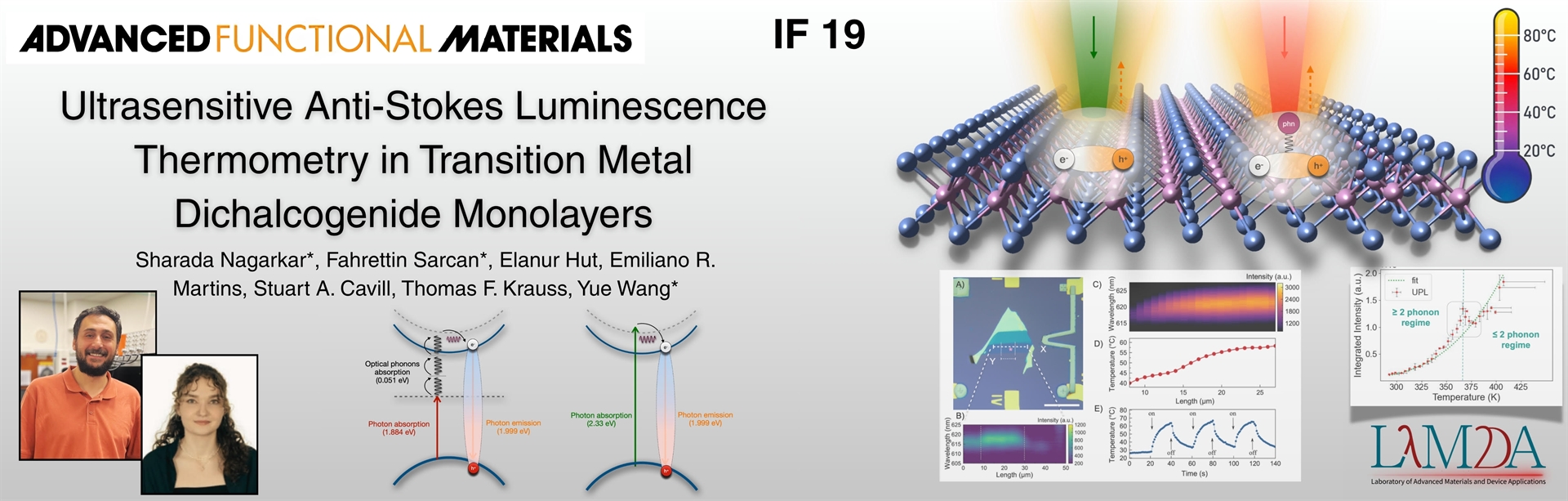
A recent study co-authored by Assoc. Prof. Dr. Fahrettin Sarcan from the Department of Physics, Faculty of Science, Istanbul University, who contributed as a corresponding author, and Research Assistant Elanur Hut has been published in in Advanced Functional Materials, one of the leading journals in materials science and advanced technologies with an impact factor of 19.
The publication is among the highest impact factor papers published with a corresponding author affiliation from our faculty.
The research was conducted within the LAMDA Research Laboratory and the Advanced Lithography Techniques Research Laboratory at Istanbul University.
The study addresses one of the major challenges in modern science and technology: accurate temperature measurements at the nanoscale. Using anti-Stokes photoluminescence (photoluminescence upconversion, UPL) in monolayer WS₂, the researchers demonstrated a highly sensitive nanothermometer with a relative sensitivity exceeding 4% K⁻¹ over the temperature range of 300–425 K, placing it among the best-performing nanothermometer materials reported to date.
In addition, the researchers introduced a new analytical framework describing the UPL mechanism by considering phonon populations, bandgap narrowing, and substrate effects. The team also successfully mapped a 20 °C thermal gradient across a 20 µm long monolayer with a spatial resolution of 1 µm.
These findings establish monolayer transition metal dichalcogenides as a promising platform for non-invasive thermal sensing in future microelectronic, photonic, and biological systems.
We congratulate our researchers on this important scientific achievement and wish them continued success in their future studies.
Access the article: https://doi.org/10.1002/adfm.75962